



Planning to explore Makkah beyond Masjid al-Haram? From the Cave of Hira to sites linked with the Prophet’s ﷺ life, each place has its own history. These places give you a chance to learn more about important events in Islam and the early days of the Muslim community.
This guide covers eight of the best-known places to visit in Makkah. For each one, you get the history, why it matters, what you can see and how hard it is to reach. One point first: Ziyarat is optional. It is not part of Umrah, and your Umrah is complete without it.If you are new to the rites, start with our step-by-step Umrah guide.
Before you start planning, check the current access rules for each site. They can change, especially around Hajj.
What Is Ziyarat in Makkah?
Ziyarat means “visiting”. For pilgrims, it usually means a trip to historical Islamic places near the Haram. People go to picture the events they have read about and to feel closer to the early Muslim community.
Is it compulsory during Umrah? No. Umrah has its own acts: entering Ihram, Tawaf, Sa’i and trimming the hair. Ziyarat sits outside that list, so skipping it does not affect your Umrah.
Think of it as a learning trip. You can go with a guide who knows the history or on your own. Either way, keep your intention simple: to learn and to reflect, not to collect rewards that no authentic text promises.
8 Famous Places to Visit in Makkah During Umrah
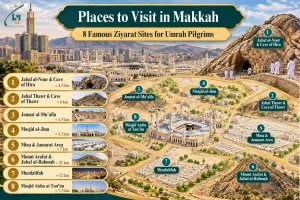
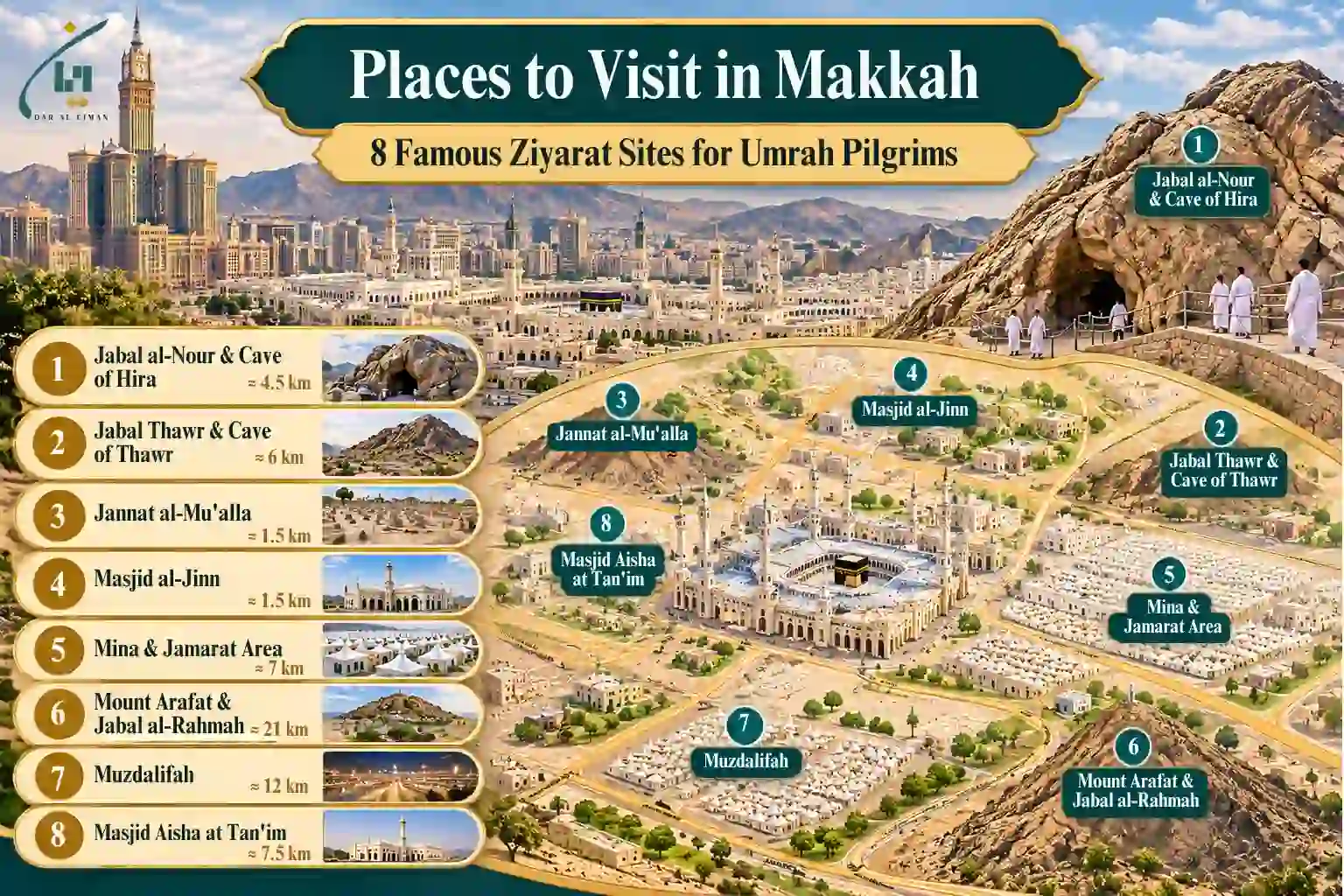
Makkah holds several places tied to key moments in Islamic history. Here are eight places you can visit after your Umrah, with the story behind each one and what to expect when you arrive.
1. Jabal al-Nour and the Cave of Hira
Jabal al-Nour, the Mountain of Light, rises a few kilometres from the Haram. The Cave of Hira sits near its top. Before prophethood, Muhammad ﷺ went there to reflect in quiet. In Ramadan, the angel Jibril came to him with the first verses of the Qur’an, which begin with “Read” (Surah Al-Alaq).
The climb is steep and difficult. A stepped path helps, but the walk can take an hour or more each way. The cave itself is small and often crowded. Start early, wear sturdy shoes and carry water.
Can you visit without climbing? Yes. You can see the mountain from the base and still reflect on its history. Climbing is not required, and no special reward for doing so is established.
2. Jabal Thawr and the Cave of Thawr
Jabal Thawr lies south of Makkah. When the Quraysh plotted against the Prophet ﷺ, he left with Abu Bakr (رضی اللہ عنہما ) (may Allah be pleased with him) and hid in a cave here for three nights. Then they continued the Hijrah to Madinah. The Qur’an mentions the two in the cave (Surah At-Tawbah, 9:40).
Popular tellings add a spider’s web over the entrance and a dove’s nest. Scholars question how well those details are established, so stick to what the Qur’an and authentic reports state.
The climb here is tougher than Hira, with rougher ground and a steeper path. Many visitors stop at the base. Skip the climb if you have knee, heart or breathing problems, and never go alone in hot weather.
3. Jannat al-Mu’alla
Jannat al-Mu’alla, also called al-Hajun, is the old cemetery of Makkah. Khadijah, the Prophet’s first wife (may Allah be pleased with her), is buried there, along with other members of his family and early Muslims. It is a place for remembering the people who carried Islam through its hardest years.
Access is limited. Visitors often view the cemetery from outside, and women are generally not allowed in. Do not assume you can enter, and follow the signs and the staff.
Keep your conduct simple. Stay quiet and respectful, and make dua to Allah alone for those buried there. Do not touch the graves or perform any ritual around them.
4. Masjid al-Jinn
Masjid al-Jinn stands close to Jannat al-Mu’alla. Tradition links the spot to the night the jinn listened to the Prophet ﷺ reciting the Qur’an, which Surah Al-Jinn and Surah Al-Ahqaf (46:29 to 32) describe. The exact location is a matter of tradition, not certainty.
Expect a modest mosque and a short stop. You can pray two rakahs if the mosque is open, or simply recall the verses and move on. Many groups pair it with Jannat al-Mu’alla because the two are near each other.
5. Mina and the Jamarat Area
Mina is a valley east of Makkah, famous for its tent city. During Hajj, pilgrims spend the nights of the 8th and the days after Eid there. The Jamarat are three pillars where pilgrims throw pebbles, remembering Ibrahim (peace be upon him) rejecting Shaytan.
Outside Hajj, Mina is mostly quiet, and the tents stand empty. Access to the Jamarat area may be restricted at certain times, so check before you go. You will not perform any Umrah rite here.
If you want the full Hajj context, read our guide on What Is Hajj.
6. Mount Arafat and Jabal al-Rahmah
Arafat is a wide plain roughly 20 km from the Haram. On the Day of Arafah, pilgrims stand there from midday until sunset, making dua. The Prophet ﷺ said that Hajj is Arafah, so missing it means missing Hajj.
Jabal al-Rahmah, the Mount of Mercy, is a small hill on the plain. People often link it to the Farewell Sermon. Scholars note that the sermon was given in a nearby valley and that standing anywhere within Arafat’s boundaries counts during Hajj. Climbing the hill is not required.
Outside Hajj, Arafat is a hot, open stretch with little shade. Bring water and a hat, and expect uneven ground near the hill.
7. Muzdalifah
Muzdalifah sits between Arafat and Mina. After sunset on the Day of Arafah, pilgrims travel there, pray Maghrib and Isha together, and spend the night. Many collect pebbles for the Jamarat while they are there. The Qur’an mentions the area as al-Mash’ar al-Haram (Surah Al-Baqarah, 2:198).
Outside the Hajj season, Muzdalifah is open ground with very little to see. Most visitors treat it as a short stop on the road between Mina and Arafat. Go for the history and not for the scenery.
8.Masjid Aisha at Tan’im
Masjid Aisha, also called Masjid al-Tan’im, sits a short drive from the Haram. It is named after Aisha (may Allah be pleased with her), who entered Ihram here for Umrah at the Prophet’s instruction ﷺ after Hajj. Today, pilgrims already in Makkah go there to enter Ihram for another Umrah.
Is that required? No. If you came from the UK and entered Ihram at your Miqat, your Umrah is complete. Scholars differ on repeating Umrah during one trip, so ask a trusted scholar before you decide. A visit to the mosque is optional either way.
Which Ziyarat Places in Makkah Can You Visit Without Climbing?
Not everyone can hike a mountain, and nobody needs to. Here is how the sites compare.
Involve climbing:
- Jabal al-Nour and the Cave of Hira
- Jabal Thawr and the Cave of Thawr
Need little walking:
- Masjid Aisha at Tan’im
- Masjid al-Jinn
- Jannat al-Mu’alla (usually seen from outside)
- Mina, Muzdalifah and Arafat (reached by vehicle, with short walks)
Jabal al-Rahmah has steps, but the rise is gentler than the two caves. Even so, the ground is uneven and the sun is strong.
If you are elderly, pregnant or managing a health condition, choose the easier sites. You do not need to climb every mountain to complete your Ziyarat. Seeing a place from the road is still a visit.
How to Plan Your Makkah Ziyarat Tour
Listing the places is easy. It depends on your fitness and the traffic. Some people manage it, but the day gets long. Even one mountain climb can fill a morning in the heat.
Choose the sites that matter most to you. Many pilgrims split the visits over two outings: mountains on one day, then the mosques and open plains on the other.
Suggested Route for Visiting Historical Places in Makkah
Group the sites by area to save time:
- Central and north: Jannat al-Mu’alla and Masjid al-Jinn sit near each other. Jabal al-Nour lies to the north-east.
- Northwest: Masjid Aisha at Tan’im.
- East: Mina, Muzdalifah and Arafat follow one another along the same road.
- South: Jabal Thawr, which suits its own trip.
Treat this as a suggestion, not a fixed plan. Traffic and access can change, and your driver may know a better order for the day.
How Can You Travel Between Makkah Ziyarat Places?
You have a few options:
- Private taxi or hired car: Flexible, and you set the pace.
- Group Ziyarat tour: A guide explains the history, and the route is planned for you.
- Transport arranged by your travel provider: Available with some packages.
Before you book, confirm the waiting time at each stop, the number of stops and the return arrangements. Agree on the price in advance. Do not rely on a verbal promise.
Important Ziyarat Tips for Families, Women and Elderly Pilgrims
- Match the sites to your group’s walking ability before you set out.
- Plan breaks and carry plenty of water.
- Wear comfortable shoes and light, modest clothing.
- Check transport and access arrangements in advance.
- Keep children close in busy spots, and agree on a meeting point.
- Skip hard climbs if they do not suit your health.
Women should check access rules before visiting places such as Jannat al-Mu’alla. Our guide to Umrah for Women from the UK covers wider travel points. Families can compare Family Umrah Packages to find hotel and transport setups that suit children and older relatives.
What Should You Prepare Before Going for Ziyarat in Makkah?
Pack this the night before:
- Comfortable walking shoes.
- Water and any personal medicine.
- Your phone and a portable charger.
- Your hotel address and contact number.
- Your transport arrangements, written down.
- Suitable clothing for sun and cool mornings.
- Confirmation that each site is open to visitors.
Spend a few minutes on your supplications as well. Our Complete Umrah Dua List can help you pick duas whose meanings you understand.
Important Things to Know Before Visiting Holy Places in Makkah
- Follow local rules. Staff and signs exist for safety, so listen to them.
- Respect cemetery etiquette. Stay quiet and avoid rituals at graves.
- Question popular stories. Not every tale told at these sites is religiously established.
- Check with a trusted scholar if something sounds uncertain.
- Keep Ziyarat in its place. It is optional, and it never replaces any part of Umrah.
- Check current restrictions. Access can change, particularly around Hajj.
Plan Your Umrah Journey from the UK with Dar Al Eiman
A good Ziyarat starts with a good base. Think about your travel dates, your hotel and the transport you need. If you travel as a family, count the walking distances for children and older relatives.
Dar Al Eiman can help you compare options for Umrah Packages from UK or check the December Umrah Packages 2026 if you travel over the school break. Read our Umrah Visa guide before you book, and ask the team what each package includes.