

Tawaf means walking around the Kaaba seven times. Every Muslim who does Umrah or Hajj must do this and recite the Tawaf duas in each round. At first it looks simple, but for many pilgrims from the UK, it becomes the most emotional part of the trip.
Many pilgrims ask the same question before they fly out: what to read during Tawaf? The honest answer is simple, since there is no fixed dua for each of the 7 rounds. In fact, scholars like Ibn Taymiyyah confirm this in Majmu al-Fatawa (26/122), so you are free to recite the Quran, make your own dua, or repeat dhikr. Above all, what matters is a sincere heart, not perfect words.
This guide gives you tawaf duas for all 7 rounds, each one written in Arabic, with the sounds spelled out and the English meaning alongside it. Every tawaf dua in Arabic comes with a clear transliteration, so you never need to guess how to say it.
Before you fly out, check our Umrah Packages. This way, your travel and stay are sorted, so you can focus fully on your worship once you land in Makkah.
Why Dua During Tawaf Matters
Tawaf is not just walking, since it is worship of the heart while your body moves around the House of Allah. The Prophet, peace be upon him, said that Tawaf, walking between Safa and Marwah, and stoning the pillars were all established to help us remember Allah (Sunan Abi Dawud 1888). This is exactly why Tawaf Dua matters so much during this ritual and why so many pilgrims plan their Tawaf Duas before they even land in Makkah.
Some pilgrims feel they must recite long Arabic pages from a booklet, even without understanding the words, and this pulls their mind away from the moment. A short dua said with real feeling is worth more than a long one recited without understanding. This is why a simple set of tawaf duas for 7 rounds, built around clear themes, often works better for pilgrims than a long, unfamiliar booklet full of unfamiliar phrases.
How to Prepare Before Tawaf
A few small steps before you start will make things calmer.
Do wudu first. You must have wudu before Tawaf, since it is treated like prayer. If it breaks, step aside, do wudu again, and then return to where you stopped.
Set your intention. Before your first step, quietly plan in your heart that you are performing Tawaf for Allah, since there are no set words for this. A simple, honest thought is enough.
Find the Black Stone line. Tawaf starts and ends at the Black Stone, known as Hajar al-Aswad, so look for the marked line on the floor near that corner. Then keep the Kaaba on your left as you walk.
Mind your manners. The area around the Kaaba gets very busy during peak season. When you are there, keep your voice low and avoid pushing. Also, give space to older people and those in wheelchairs, and if you cannot reach the Black Stone, simply raise your hand toward it and say Allahu Akbar as you pass.
If you travel with family or a group, our Hajj Packages come with guided support, including help thinking through which tawaf duas to prepare in advance. As a result, everyone knows what to expect at each step of the journey.
How to Perform Tawaf With Dua, Step by Step
Once your wudu is done and intention set, the steps are simple. Start level with the Black Stone, say Bismillah, Allahu Akbar, then walk with the Kaaba on your left. Keep a steady pace through all 7 rounds, slowing only if the crowd forces you to. Between the Yemeni Corner and the Black Stone, in every round, say the one confirmed Sunnah dua.
For the rest, use the themed duas below, your own personal dua, or simple tawaf tasbeeh, such as SubhanAllah and Alhamdulillah. When you finish round seven, your Tawaf is complete, and you can move on to pray two rakahs near Maqam Ibrahim before Sa’i.
Tawaf Duas for Each of the 7 Rounds
None of these duas are compulsory word for word. Instead, think of them as themes for your heart in each round. Where a dua comes straight from the Quran or a strong hadith, we give you the source so you know which of these tawaf duas are Prophetic and which are simply helpful ideas.
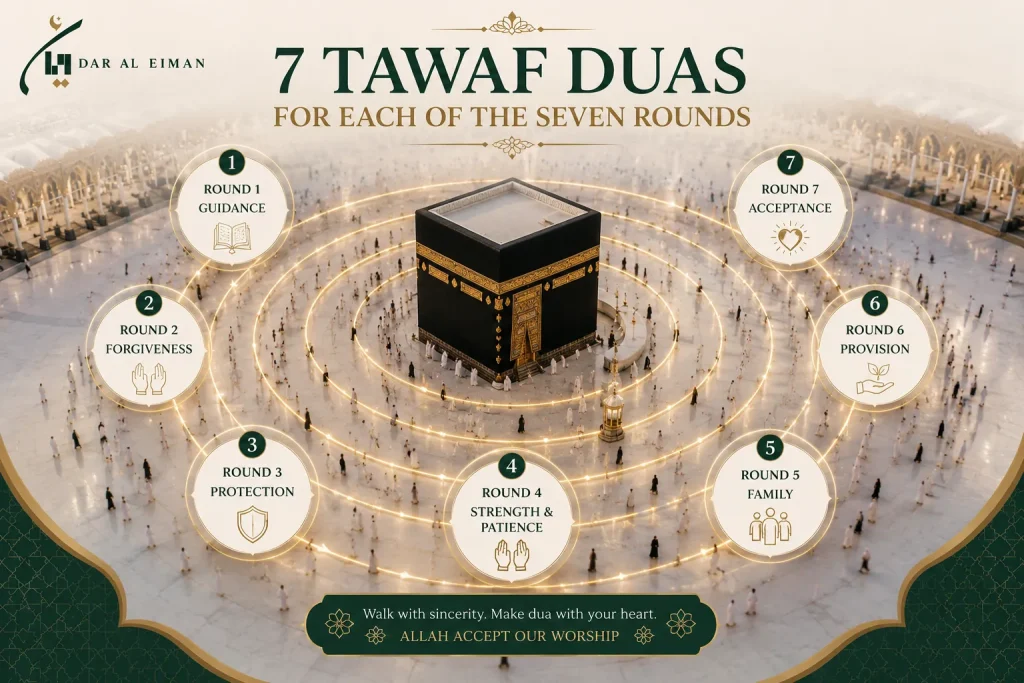
Round 1: Guidance
Arabic: اللَّهُمَّ إِنِّي أَسْأَلُكَ الْهُدَى وَالتُّقَى وَالْعَفَافَ وَالْغِنَى
Transliteration: Allahumma inni as’aluka al-huda wat-tuqa wal-‘afafa wal-ghina
Translation: O Allah, I ask You for guidance, piety, chastity, and self-sufficiency.
Reference: The Prophet (peace be upon him) said: In Sahih Muslim (2721).
Reflection: Start by asking Allah to guide your whole life. Don’t just for this trip.
Round 2: Forgiveness
Arabic: رَبِّ اغْفِرْ لِي وَارْحَمْنِي وَتُبْ عَلَيَّ إِنَّكَ أَنْتَ التَّوَّابُ الرَّحِيمُ
Transliteration: Rabbighfir li warhamni wa tub ‘alayya innaka antat-Tawwabur-Raheem
Translation: My Lord, forgive me, have mercy on me, and accept my repentance. You are the One who accepts repentance, the Merciful.
Reference: Based on the dua said between the two bows in prayer, found in Sunan Abu Dawood (850).
Reflection: Use this round to reflect on your sins and ask Allah for forgiveness. After all, Allah already knows them.
Round 3: Protection
Arabic: اللَّهُمَّ أَجِرْنِي مِنَ النَّارِ
Transliteration: Allahumma ajirni minan-nar
Translation: O Allah, protect me from the Fire.
Reference: Reflects the second half of the Quran verse in Surah Al-Baqarah (2:201).
Reflection: Ask for safety in this life and the next. And also ask for your family too.
Round 4: Strength and Patience
Arabic: رَبَّنَا أَفْرِغْ عَلَيْنَا صَبْرًا وَثَبِّتْ أَقْدَامَنَا وَانْصُرْنَا عَلَى الْقَوْمِ الْكَافِرِينَ
Transliteration: Rabbana afrigh ‘alayna sabran wa thabbit aqdamana wansurna ‘alal qawmil kafirin
Translation: Our Lord, give us patience. Make our steps firm. Help us.
Reference: A direct verse from the Quran, Surah Al-Baqarah (2:250).
Reflection: By round four, your legs may feel tired. So, ask for patience to keep going.
Round 5: Family
Arabic: رَبَّنَا هَبْ لَنَا مِنْ أَزْوَاجِنَا وَذُرِّيَّاتِنَا قُرَّةَ أَعْيُنٍ وَاجْعَلْنَا لِلْمُتَّقِينَ إِمَامًا
Transliteration: Rabbana hab lana min azwajina wa dhurriyyatina qurrata a’yunin waj’alna lil-muttaqina imama
Translation: Our Lord, give us joy through our spouses and children. Make us leaders for the righteous.
Reference: From the Quran, Surah Al-Furqan (25:74).
Reflection: Think of your parents, spouse, or children in this round. Also, include those who could not travel with you.
Round 6: Provision and Success
Arabic: اللَّهُمَّ إِنِّي أَسْأَلُكَ رِزْقًا حَلَالًا طَيِّبًا وَعَمَلًا مُتَقَبَّلًا
Transliteration: Allahumma inni as’aluka rizqan halalan tayyiban wa ‘amalan mutaqabbalan
Translation: O Allah, I ask You for pure, lawful provision and the deeds that are accepted.
Reference: A well-known Tawaf dua that follows the Sunnah way of asking for good, halal provision.
Reflection: Provision is not just money. It is also health and good chances in life. Ask that these duas bring you closer to Allah.
Round 7: Acceptance
Arabic: اللَّهُمَّ تَقَبَّلْ مِنَّا هَذَا الطَّوَافَ وَاغْفِرْ لَنَا ذُنُوبَنَا
Transliteration: Allahumma taqabbal minna hadhat-tawaf wa ighfir lana dhunubana
Translation: O Allah, accept this Tawaf from us and forgive our sins.
Reference: Follows the Prophetic teaching to always ask Allah to accept our worship. Not to assume it is already accepted.
Reflection: Thank Allah for letting you finish this act of worship. Then ask Him to accept it, since only He decides that.
Dua Between Yemeni Corner and Black Stone
One dua for Tawaf stands out from the rest, often searched as the dua between Yemeni Corner and Blackstone. It comes straight from the Prophet, peace be upon him, in Sunan Abi Dawud (1892). Abdullah ibn as-Sa’ib said the Prophet recited it in the short walk between the Yemeni Corner and the Black Stone in every round.
Arabic: رَبَّنَا آتِنَا فِي الدُّنْيَا حَسَنَةً وَفِي الْآخِرَةِ حَسَنَةً وَقِنَا عَذَابَ النَّارِ
Transliteration: Rabbana atina fid-dunya hasanatan wa fil akhirati hasanatan wa qina ‘adhaban-nar
Translation: Our Lord, give us good in this world and good in the next. Protect us from the fire.
This exact line also appears in the Quran, Surah Al-Baqarah (2:201). Anas ibn Malik said this was the dua the Prophet said most often in his life, according to Sahih al-Bukhari (6389) and Sahih Muslim (2690). Since it is so short, it fits easily into the few steps between the two corners, and many pilgrims repeat it every round.
What Scholars Say About Duas for Tawaf
Some guides claim you must say one exact Tawaf dua for each round and that your Tawaf is worth less if you skip it, but this is not correct. Ibn Taymiyyah said no set dhikr was ever taught by the Prophet for Tawaf, other than the one dua at the Yemeni Corner, and that a pilgrim is free to recite any part of the Quran or Sunnah for the rest of the walk (Majmu al-Fatawa, 26/122). So if you forget a theme, your Tawaf remains valid, and choosing the perfect tawaf duas is never a strict requirement.
Dhikr for Any Round
Some rounds will feel rushed, and you may simply forget the words above, which is completely fine. When memorized tawaf duas slip your mind, just fall back on short dhikr instead.
- SubhanAllah, which means “Glory be to Allah.”
- Alhamdulillah, which means All praise is for Allah
- Allahu Akbar, which means Allah is the Greatest
- La ilaha illallah, which means There is no god but Allah
- Astaghfirullah, which means I seek forgiveness from Allah
You can say these on a loop, count them on your fingers, or say them quietly in your heart. Dhikr is never wrong, even in a big crowd.
Tips and Common Mistakes to Avoid
Keep a steady pace. Tawaf is worship, not a race. So a slow pace with honest dua beats a fast pace with rushed words.
Focus on meaning, not memorising. If Arabic is not your first language, read the English meaning in your mind instead. Allah wants honesty, not perfect sounds.
Do not think a fixed dua is required. As we said above, this is a myth. Do not worry if you forget the words for one round.
Do not let your phone take over your focus. A dua card or app is a good backup, but looking down too much pulls you out of the moment. Treat any printed tawaf duas as a small prompt, not a full script.
Remember the Sunnah dua at the Yemeni Corner. This is the one dua we know for sure came from the Prophet’s own practice. So try to keep this one close in your memory.
Respect the people around you. Do not recite loudly, and do not stop suddenly, since this can cause people to bump into you.
After Tawaf, most pilgrims pray two rakahs near Maqam Ibrahim if they can. Then they drink Zamzam water and move on to Sa’i between Safa and Marwah. Having your tawaf duas ready in advance means you can move into this next stage without feeling rushed. If you want the full list of duas for that next step, read our Sa’i Guide or Dua Collection.
Tawaf is not about saying the right words in the right order. Instead, it is about turning your heart to Allah while your body moves around His House. The tawaf duas in this guide give you a starting point for each round. Still, you can always add your own words, in your own language, for your own life.
If you are still planning your umrah trip, visit us at Dar Al Eiman and see how we can help you, from booking to the day you stand in front of the Kaaba.
FAQs
Is there a fixed dua for each round of Tawaf?
No, Islam does not require one set dua for each round. Instead, you can recite the Quran, make your own dua, or repeat dhikr. Ibn Taymiyyah confirmed this in his book, Majmu al-Fatawa.
What if I cannot remember any Arabic dua?
Do not worry at all. You can just say simple words of praise like SubhanAllah, Alhamdulillah, and Allahu Akbar. Allah understands every single language, so you can absolutely make your own personal language you speak at home.
Can I read a dua from my phone during Tawaf?
Yes, you can. Lots of pilgrims use dua apps or handy pocket cards. Just make sure to keep your phone on silent and stay alert so you do not accidentally bump into the people walking around you.
What is the most important dua to remember during Tawaf?
The most important one is the short prayer said between the Yemeni Corner and the Black Stone: “Rabbana atina fid-dunya hasanatan…” This is the only specific dua we know for sure the Prophet ﷺ repeated in every single round, and it comes straight from the Quran.
Do I need to finish all 7 rounds without stopping?
It is best to finish them without a break. But if your wudu breaks, or you need a short rest for health reasons, most scholars say you can step aside. Then you can come back and continue.
Is the Arabic version more valuable than the dua in English?
Arabic follows the exact words of the Quran and Sunnah, so many pilgrims find these tawaf duas meaningful in their original form. Still, dua in English is fully valid too, since what matters most is a sincere heart.
References
- Quran, Surah Al-Baqarah 2:201 and 2:250
- Quran, Surah Al-Furqan 25:74
- Sahih Muslim 2721 and 2690
- Sahih al-Bukhari 6389
- Sunan Abi Dawud 850, 1888, and 1892
- Ibn Taymiyyah, Majmu al-Fatawa 26/122