



Madinah is a city where faith, history and peace come together. This is the city that welcomed the Prophet Muhammad ﷺ, and its streets and hills still carry the memory of his life and the lives of his companions. If you’re heading there for Umrah, set aside some time for ziyarat. These eight places are among the most well-known, and visiting them brings the history you’ve read about to life.
This guide covers the best-known places to visit in Madinah, with the history behind each one, rough distances and tips for planning your time. Clearly know that Ziyarat is optional. It is not part of Umrah, and your Umrah is complete without it. Think of these visits as a chance to learn and reflect.
Planning your trip? See our Umrah packages from the UK.
Why Visit Historical Places in Madinah?
Most pilgrims want to see where the early Muslim community lived, prayed and struggled. Walking through these places helps you picture the Hijrah, the first mosques and the battles that shaped Madinah.
You also see how the city grew around a few key sites. The Prophet’s Mosque sat at its centre, and settlements formed around it.
Keep your expectations simple. A place can carry deep historical meaning without a special reward attached to visiting it. Where a reward is mentioned, it needs a reliable source. Ask a trusted scholar if you are unsure about a claim you hear at a site.
Famous Places to Visit in Madinah
Madinah is home to several important Islamic sites, each with its own history and significance. Here are some of the most famous places you can visit during your stay.
1. Al-Masjid an-Nabawi (The Prophet’s Mosque)
The Prophet ﷺ built this mosque soon after arriving in Madinah. It became a place for prayer, teaching and community life. Today it is one of the busiest and most revered mosques in the world.
The sacred chamber also houses the resting place of the Prophet Muhammad (alongside the graves of Abu Bakr and Umar (رضی اللہ عنہما ). Visit with calm manners. Keep your voice low, do not block walkways and follow the staff. Many people are praying close by.
2. Rawdah ash-Sharifah (The Noble Garden)
The Rawdah is the area between the Prophet’s house and his pulpit. A well-known hadith describes it as a garden from the gardens of Paradise.
You cannot just walk in. Entry is possible through a permit system, which you can obtain from the Nusuk app, with separate slots for men and women. Slots and times change, and they can fill up fast, so check Nusuk for the latest arrangements. Do not assume you will get in. If you miss out, you can still pray elsewhere in the mosque.
3. Jannat al-Baqi
Jannat al-Baqi is the old cemetery of Madinah, next to the Prophet’s Mosque. Many companions and members of the Prophet’s family are buried here.
Access may be restricted, with different rules for men and women. Check visiting arrangements locally before you go. Stay calm, avoid touching graves and make dua to Allah alone.
4. Masjid Quba
Masjid Quba is the first mosque built in Islam. The Prophet ﷺ reached Quba during the Hijrah, before entering Madinah, and he helped build the mosque himself.
It lies roughly 3.5 km from the Prophet’s Mosque by road. A taxi is the easiest way. As a hadith reported in Ibn Majah speaks of reward for praying here after making wudu at home. Scholars have discussed its grading, so ask a trusted scholar if you want to be sure.
5. Masjid al-Qiblatayn
The name means “the mosque of two qiblas”. Early Muslims prayed towards Jerusalem, and later Allah directed them to face the Kaaba, as Surah Al-Baqarah (2:144) describes. Tradition places that change here.
It is located roughly 3.8 km from the Prophet’s Mosque by road, in the northwest. Allow time to read the history. The prayer hall is small, so it can feel crowded at busy hours.
6. Masjid al-Jumu’ah
Historical accounts link this mosque to the first Friday prayer the Prophet ﷺ led after the Hijrah, as he travelled from Quba towards Madinah. It stands in the Quba area, so many visitors pair it with Masjid Quba.
Treat it as a historical stop. It is not a required part of Umrah.
7. Mount Uhud and the Uhud Martyrs’ Cemetery
Mount Uhud lies north of the city, roughly 5 km from the Prophet’s Mosque. The Battle of Uhud took place here in 3 AH. Hamza ibn Abdul Muttalib (may Allah be pleased with him), the Prophet’s uncle, and many other Muslims were martyred.
You can see the cemetery and the small hill called Jabal al-Rumah, where the archers stood. The ground is open, and the sun is strong, so bring water and a hat. Usually, visitors view the cemetery from the edge, and women may find access limited.
Elderly pilgrims can often see the site from the car park without a long walk. Pick what suits your energy.
8. Masjid al-Ghamamah
Masjid al-Ghamamah stands a short walk from the Prophet’s Mosque. History links it to the first Eid prayers conducted by the Prophet ﷺ. Scholars and historians differ on some details, so treat the popular stories with care.
It pairs well with a walk around the mosque area. You do not need transport.
Miqat from Madinah to Makkah (Dhul Hulayfah (Abyar Ali))
Dhul Hulayfah is not a sightseeing stop. It is the Miqat for pilgrims travelling from Madinah to Makkah. If you plan to perform Umrah after your Madinah stay, you enter Ihram here before you continue to Makkah.
It lies roughly 13 to 14 km from the Prophet’s Mosque. Keep it separate from your Ziyarat list. Learn about it before you leave, so you are ready to make your intention.
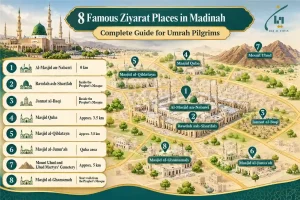
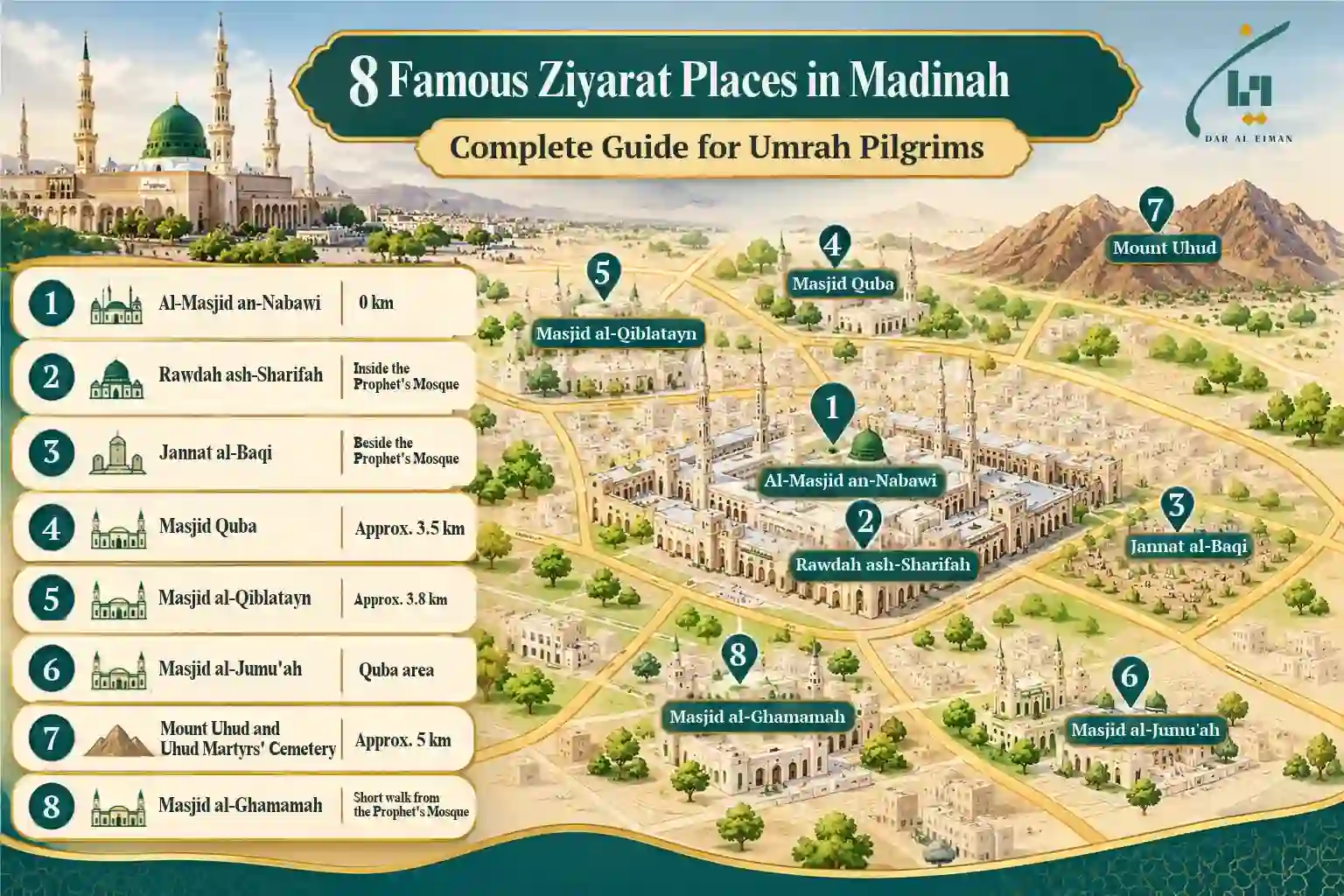
Madinah Ziyarat Map: Where Are These Places?
This map shows the sites around Madinah. Three places lie in the central area and are within walking distance of the Prophet’s Mosque: the mosque itself, the Rawdah and Jannat al-Baqi. Masjid al-Ghamamah is a short walk away too.
Quba, Jumu’ah, Qiblatayn and Uhud need a taxi or organised transport. Group nearby places in one trip, which saves time and money.
Distances here are rough road distances from the Prophet’s Mosque, not straight lines. Travel time shifts with traffic, prayer times and crowd rules, so recheck before you go.
A Practical Half-Day Ziyarat Route in Madinah
If you want to visit several historical sites in one trip, you can follow this half-day route. It covers four places outside the central mosque area, starting with Masjid Quba and ending at Mount Uhud. This is a suggested route, not a fixed itinerary.
| Order | Location | What to Explore |
| 1 | Masjid Quba | The first mosque built in Islam |
| 2 | Masjid al-Jumu’ah | The place linked to the first Friday prayer after the Hijrah |
| 3 | Masjid al-Qiblatayn | The history of the change of Qiblah |
| 4 | Mount Uhud and the Martyrs’ Cemetery | The story of the Battle of Uhud |
A few tips make the morning smoother:
- Start after breakfast, or pick a cooler part of the day.
- Leave time for prayer, walking and rests.
- Do not rush between sites.
- Check access before you set off.
- Keep the Prophet’s Mosque, the Rawdah and Jannat al-Baqi as separate visits, since they sit in the central area.
Practical Tips for Planning Madinah Ziyarat
- Check your Rawdah booking: Book through Nusuk and follow the time on your permit. Visiting periods may differ for men and women, and they can change.
- Check Jannat al-Baqi access: The cemetery is not open at all times, and not every visitor has the same access.
- Choose suitable transport: For sites beyond the central mosque, book a taxi or organised transport with a driver who knows the routes.
- Plan around prayer times: Roads and pavements get very busy around prayer. Plan to set off well before the prayer starts, or wait until the crowds clear.
- Wear comfortable shoes: Pick something comfortable, because most visits mean a lot of standing and walking.
- Carry water: To avoid dehydration, bring water along with you. Because outdoor sites like Uhud get hot, even in winter sun.
- Support elderly pilgrims: Ask about wheelchairs, check how far you will walk and plan rest stops.
- Plan for children: Keep each visit short, and do not schedule too many places in one day.
- Respect etiquette: Follow local instructions and keep your voice low near people who are praying.
Women travelling from the UK can learn from our Umrah for Women from the UK guide for advice on travel and visiting the Rawdah. Also, families can compare Family Umrah Packages to find hotels close to the Prophet’s Mosque.
How Many Days Do You Need to Explore Madinah?
You can extend or shorten your stay duration in Madinah as per your pace. Here we have a suggestion for your three-day short trip:
- One day: Focus on the central mosque area, then add one route to the outer sites.
- Two days: Spend one day on the central sites and one on Quba, Qiblatayn and Uhud.
- Three days: Leave more room for prayer, a Rawdah appointment, Ziyarat and rest.
You do not need to see every historical place to complete Umrah. Choose what matters to you and skip the rest.
Plan Your Umrah Journey with Dar Al Eiman
A good Ziyarat starts with a good base. Think about your dates, your hotel and the time you want in Madinah. If you travel over the school break, look at December Umrah Packages 2026. Read our Umrah Visa guide before you book.
Prepare your supplications too, with our Complete Umrah Dua List. Heading on to Makkah next? Our guide to Places to Visit in Makkah covers the sites there.
Browse Umrah Packages from UK and ask the Dar Al Eiman team to confirm hotels, transfers and inclusions before you pay.