

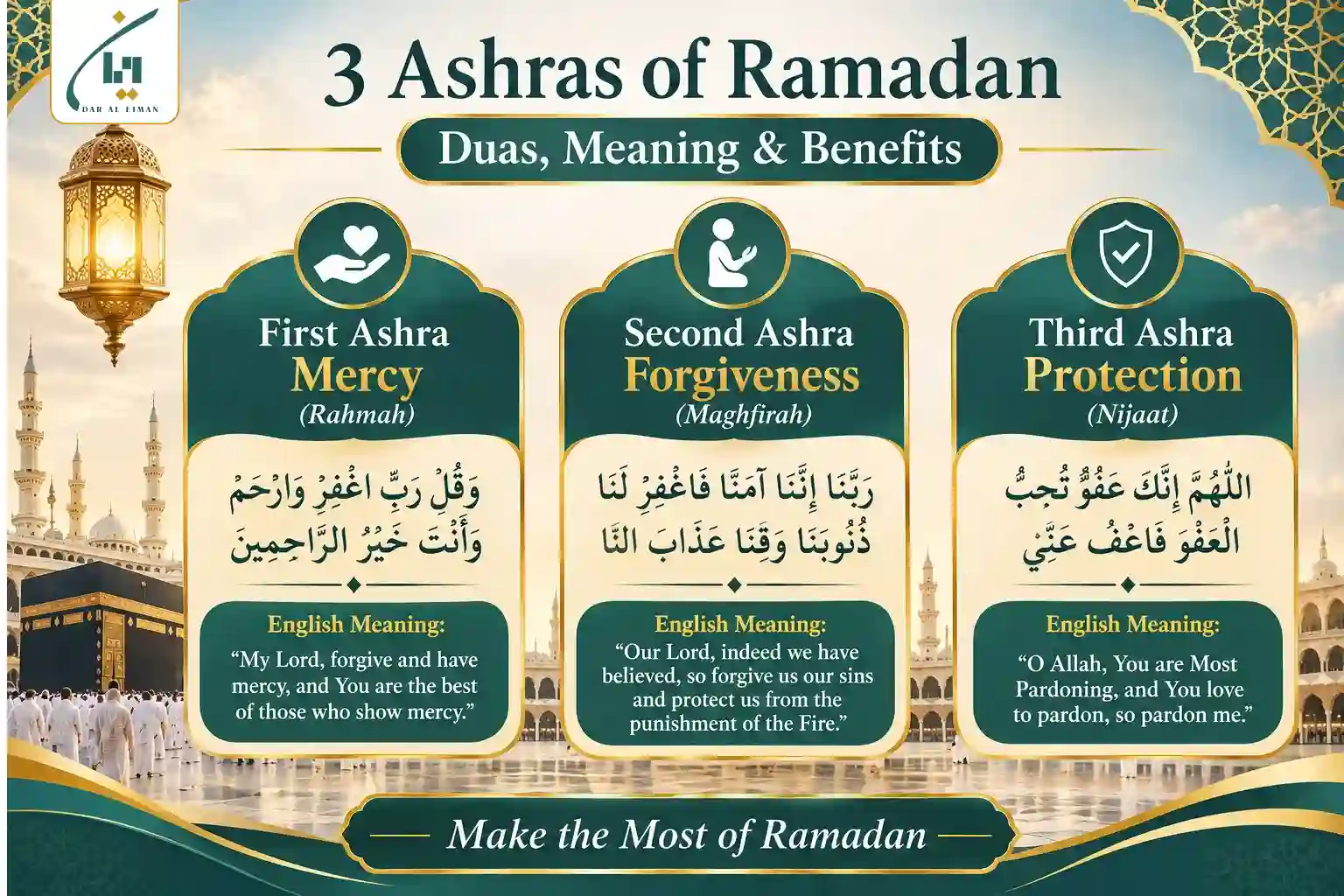
Ramadan changes the rhythm of everyday life. Muslims strengthen their faith, seek Allah’s forgiveness and fill their days and nights with worship, reflection and heartfelt duas. 3 Ashras of Ramadan are a traditional way to divide the month into three ten-day periods. Each period is specifically associated with a spiritual theme: mercy, forgiveness and seeking protection from the Fire.
The Arabic word ‘Ashra’ (عَشْرَة) refers to ten. Since Ramadan lasts either 29 or 30 days, the final Ashra may contain ten nights, while the calendar month itself can end after 29 days.
These themes can help Muslims reflect on different aspects of worship during Ramadan. A believer seeks mercy, repents, asks forgiveness and prays for protection from the Fire every day and night of Ramadan.
This guide explains the Three Ashras of Ramadan, their duas with Arabic, transliteration and English translation, and simple ways to make Ramadan more meaningful.
Ramadan’s Three Ashras: What Makes Each Ten Days Special?
Ramadan is traditionally divided into three parts:
- First Ashra: Focuses on seeking Allah’s mercy (Rahmah).
- Second Ashra: Encourages seeking Allah’s forgiveness (Maghfirah).
- Third Ashra: Emphasises seeking protection from the Hellfire (Nijaat).
This division is familiar in many Muslim communities. The narration often quoted to support these themes is found in sources including Sahih Ibn Khuzaymah, but scholars have differed over its grading, and some classify it as weak. Darul Ifta Birmingham, for example, discusses the narration as weak while noting scholarly allowance for weak narrations in certain discussions of virtues. Other scholars caution against treating the three periods as having exclusive prescribed supplications. (Darul Ifta Birmingham; IslamQA)
First Ashra of Ramadan: The First Ten Days
The first Ashra is often called the Ashra of mercy. It is a good time to reflect on Allah’s compassion, show kindness to others and begin Ramadan with sincere repentance.
Mercy is not limited to a particular period. The Qur’an repeatedly encourages believers to turn to Allah, seek forgiveness and hope in His mercy. Ramadan is a blessed time to renew your trust in Allah and set your routine of worship.
First Ashra Dua: Asking Allah for Forgiveness and Mercy
A beautiful Qur’anic dua asks Allah for both forgiveness and mercy:
Arabic:
وَقُلْ رَبِّ اغْفِرْ وَارْحَمْ وَأَنْتَ خَيْرُ الرَّاحِمِينَ
Transliteration:
Rabbi ighfir warham wa anta khayrur-raahimeen.
English meaning:
“My Lord, forgive and have mercy, and You are the best of those who show mercy.”
Qur’an, Surah Al-Mu’minun (23:118).
This short dua asks for two requests. Allah forgives what you have done wrong, and He treats you with kindness. You can recite it during the first ten days, throughout Ramadan, or at any other time.
During the first Ashra, adopt mercy in your daily life. Behave with kindness to your family, forgive others, help those in need and treat people with care. Remember, worship is not just about prayer and reciting the Quran. Kindness is also an important part of Islam.
For ideas on preparing spiritually and practically before the month begins, read How to Welcome Ramadan. A thoughtful start can help you maintain good habits as the month progresses.
The Second Ashra of Ramadan: Middle Ten Days
The second Ashra gives a chance of Maghfirah, meaning forgiveness. It is a reminder to take repentance seriously, recognise personal mistakes and ask Allah to forgive our sins.
Repentance does not come simply by saying a phrase repeatedly. Deep feelings of regret for wrongdoing, stopping your sin and sincerely intending not to return to it. When someone has hurt another person or violated their rights, they should try to make things right and ask for forgiveness.
By the middle of Ramadan, the first rush has worn off, so it is a good moment to check in with yourself. Have you kept up your prayers? Is there a habit you hoped to fix and have not? Is there someone you need to make peace with before the month ends? Answer honestly, and you may take something lasting out of Ramadan.
2nd Ashra Dua: Asking for Forgiveness
The Quran includes this prayer from the believers:
Arabic:
رَبَّنَا إِنَّنَا آمَنَّا فَاغْفِرْ لَنَا ذُنُوبَنَا وَقِنَا عَذَابَ النَّار
Transliteration:
Rabbana innana aamanna faghfir lana dhunubana wa qina adhaban-naar.
English meaning:
“Our Lord, indeed we have believed, so forgive us our sins and protect us from the punishment of the Fire.” Qur’an, Surah Aal-e-Imran (3:16).
This dua shows faith, forgiveness and protection from the Fire. It is suitable for reflection during the second Ashra, but it is not restricted to those ten days. You can recite it throughout Ramadan and beyond.
Also increase the practice of Istighfar for seeking forgiveness. This is a simple dua:
Arabic:
.أَسْتَغْفِرُ اللَّهَ وَأَتُوبُ إِلَيْه
Transliteration:
Astaghfirullaha wa atubu ilayh.
English meaning:
“I seek forgiveness from Allah and repent to Him.”
This is a general form of seeking forgiveness, not a special dua assigned to the second Ashra.
Third Ashra of Ramadan: The Last Ten Days
The third Ashra is traditionally associated with seeking salvation and protection from the Fire. These final days and nights are especially significant because they include Laylatul Qadr, the Night of Decree.
The Qur’an describes Laylatul Qadr as better than a thousand months (Surah Al-Qadr 97:3). Its exact night is not definitively identified, which is why Muslims are encouraged to seek it during the last ten nights, especially the odd-numbered nights.
Aisha (رضي الله عنها) reported that when the last ten nights began, the Prophet Muhammad ﷺ would devote himself more intensely to worship, stay awake at night and wake his family. (Sahih Muslim 1174–1175.)
This significance of the last ten nights does not mean worship earlier in Ramadan is less valuable. Rather, it is one more chance for reward in a month that already has plenty.
3rd Ashra Dua: The Dua for Laylatul Qadr
Hazrat Aisha (رضي الله عنها) asked the Prophet ﷺ what to say if she found Laylat al-Qadr. He taught her this dua:
Arabic:
.اللَّهُمَّ إِنَّكَ عَفُوٌّ تُحِبُّ الْعَفْوَ فَاعْفُ عَنِّي
Transliteration:
Allahumma innaka ‘afuwwun tuhibbul-‘afwa fa‘fu ‘anni.
English meaning:
“O Allah, You are Most Pardoning, and You love to pardon, so pardon me.”
Reference: Jami‘ at-Tirmidhi 3513. The narration is graded Hasan Sahih by Imam al-Tirmidhi.
This is a particularly meaningful Dua for Laylatul Qadr. It asks Allah not merely to forgive a specific mistake but to grant His pardon. Recite it during the last ten nights, and especially while seeking Laylatul Qadr.
There is no need to wait until the third Ashra to ask for forgiveness or protection from the Fire. You can recite these valuable duas throughout Ramadan.
Three Ashra Duas At a Glance
Here is a quick reference for the duas featured in this guide. They are useful throughout Ramadan, not only during their traditionally associated Ashra.
Purpose | Dua | Reference |
| Mercy | Wa qul rabbi ighfir warham wa anta khayrur-raahimeen. | Qur’an 23:118 |
Forgiveness | Rabbana innana aamanna faghfir lana dhunubana wa qina adhaban-naar. | Qur’an 3:16 |
| Laylatul Qadr | Allahumma innaka ‘afuwwun kareemun tuhibbul-‘afwa fa‘fu ‘anni. | Jami‘ at-Tirmidhi 3513 |
The Arabic, transliteration and meanings are provided in the relevant sections above. Transliteration is a guide to pronunciation, so listening to a reliable recitation can help if you are unfamiliar with the Arabic sounds. You can also explore our Complete Umrah Dua List for supplications that may be useful when preparing for or performing Umrah.
Set Realistic Goals for Each Ashra
To avail oneself of the countless blessings of Ramadan does not mean creating an overwhelming worship schedule. A few consistent practices, carried out sincerely, can make Ramadan more meaningful.
- Make dua often: Ask Allah for mercy, forgiveness, guidance and protection in this life and the next. Keep a short list on your phone so you remember what to ask for.
- Recite the Qur’an slowly: Set a daily target you can really keep, even one page after Fajr. A little read with understanding lasts longer than a rush.
- Maintain your five prayers: Put them first, and fit extra worship around them.
- Say sorry to Allah: Think about what you got wrong last year, and make one real change.
- Adopt charity and help: Support a local food bank, a charity you trust or a neighbour who needs a hand.
- Protect your character: Be patient with family and colleagues, especially in the last hour before Iftar. Walk away from arguments and sharp words.
- Increase worship duration: If you can, free up time in the last ten nights for prayer, Qur’an, dua and dhikr while you look for Laylat al-Qadr.
The Qur’an reminds believers that Allah is near and responds to those who call upon Him
Arabic:
وَإِذَا سَأَلَكَ عِبَادِي عَنِّي فَإِنِّي قَرِيبٌ ۖ أُجِيبُ دَعْوَةَ الدَّاعِ إِذَا دَعَانِ ۖ فَلْيَسْتَجِيبُوا لِي وَلْيُؤْمِنُوا بِي لَعَلَّهُمْ يَرْشُدُونَ
Transliteration:
Wa idha sa’alaka ‘ibadi ‘anni fa inni qareeb. Ujeebu da’watad-da’i idha da’ani. Falyastajeeboo li walyu’minoo bi la’allahum yarshudoon.
Translation:
“When My servants ask you about Me, I am indeed near. I respond to one’s prayer when they call upon Me. So let them respond to Me and believe in Me, so that they may be guided.”
Surah Al-Baqarah (2:186).
I’tikaf in the Last 10 Days of Ramadan: Meaning, Virtue and Basic Rules
I’tikaf means staying in a mosque for a set time, with the intention of worshipping Allah and drawing closer to Him. You put work and daily routine aside and spend the time in prayer, Qur’an, dhikr and dua.
The Prophet ﷺ did I’tikaf in the last ten days of Ramadan every year until he died, and his wives continued it after him (Bukhari and Muslim). He did it partly to seek Laylat al-Qadr, which is better than a thousand months. It also gives you quiet, uninterrupted time for worship and teaches self-control.
The basics are simple. Make the intention and stay in a mosque. Men should choose one that holds congregational prayers. Leave only when necessary, such as for the toilet, wudu or food. Avoid idle talk and arguments. Intimacy with your spouse breaks I’tikaf. The minimum length differs between madhhabs, so ask a scholar.
A Practical Ramadan Checklist for Daily Worship
For UK Muslims, Ramadan means to balance fast alongside work, school, family and daily prayers. Use this checklist to make preparation manageable.
Before Starting Ramadan
- Check the expected Ramadan dates and confirm the start with your local mosque. See When Is Ramadan 2027 for date planning.
- Download or save a reliable local Suhoor, Fajr and Iftar timetable.
- Plan meals and shopping so you are not rushing every evening.
- Set realistic Qur’an reading and worship goals.
- Arrange work, school or annual leave commitments where possible.
- If you take regular medication due to any health condition, speak with your GP before Ramadan. Do not change your medication timing without medical consultation.
During Ramadan
- Observe your fasts in Ramadan according to the local timetable and guidance you follow.
- Keep up with the five daily prayers.
- Make time for Qur’an, dhikr and dua.
- Give charity or help someone in need.
- Keep a balanced routine around sleep, meals and responsibilities.
- Make extra time for worship during the last ten nights if possible.
If you want to learn more about fasting itself, read this guide. What Is Sawm in Islam? For a guide to its understanding and practice.
Maximise Blessings This Ramadan Through Sincere Niyyah
The three Ashras offer a simple way to reflect on mercy, forgiveness and seeking protection from Fire. These duas and acts of worship are not limited to these ten days. You can use these duas throughout Ramadan. Also, you can plan and perform Umrah during Ramadan; explore Ramadan Umrah Packages 2027 at Dar Al Eiman and book your travel arrangements early. You can also browse our Umrah Packages from the UK to start planning your journey.
May Allah accept our fasting, prayers, repentance and duas, and allow us to benefit from every day and night of Ramadan. Ameen.