

Millions of Muslims travel to Makkah every year to perform Umrah. But first, you need to know one thing. Who can perform Umrah? And what does Islam ask of you before you go?
This guide answers that in plain words. We cover age, health, money, and paperwork. Also, we cover mahram rules for women. We look at health checks too. And we flag the mistakes that trip up new pilgrims. By the end, you will know where you stand. You will also know what to prepare.
Umrah is often called the “minor pilgrimage”. But its reward is far from minor. Unlike Hajj, Umrah has no fixed dates. You can go almost any time of year. That is why so many families plan around it. Some pick a quiet month. Others go during a school holiday.
Who Is Eligible to Perform Umrah?
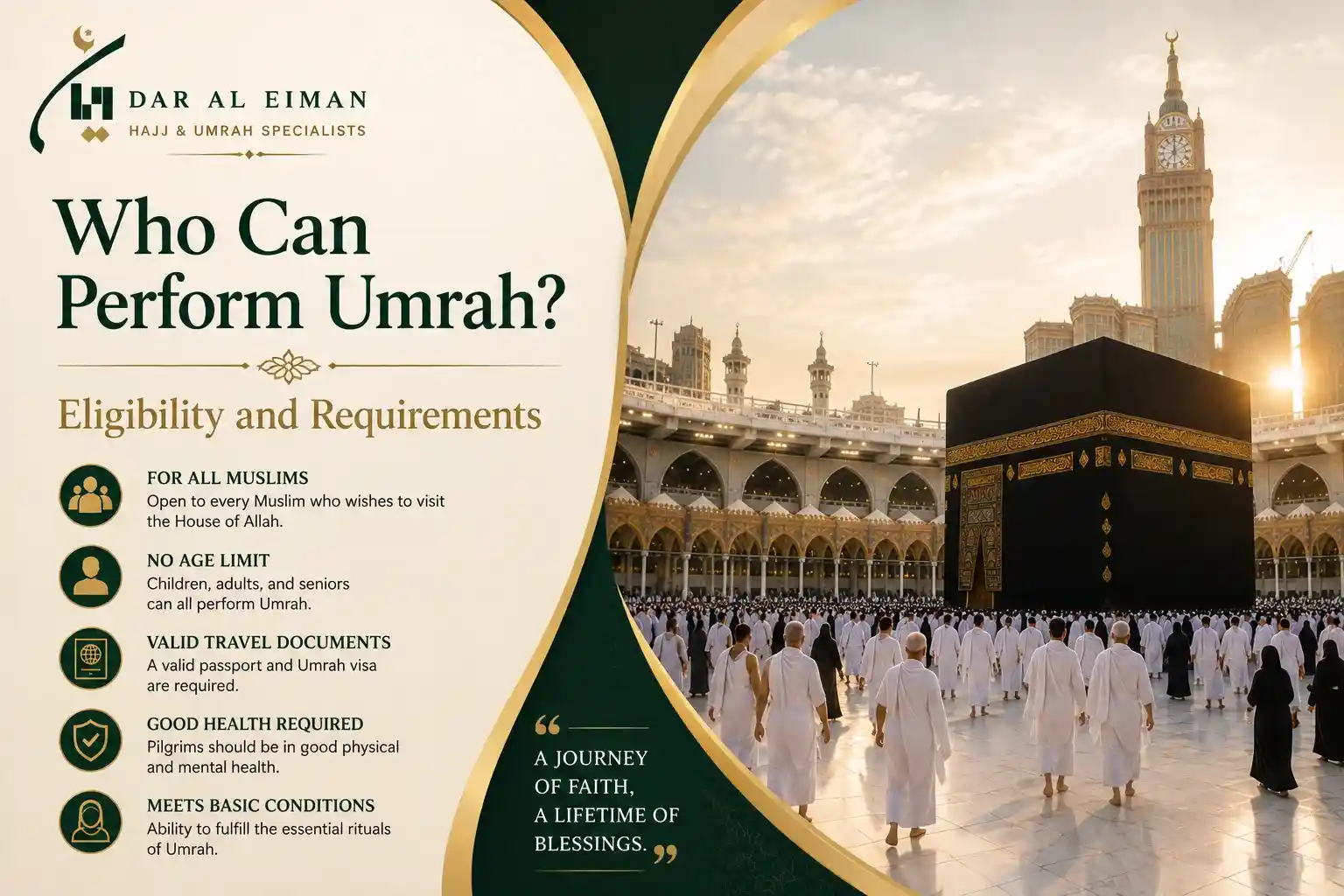
The answer is simple. Any Muslim can perform Umrah, male or female and young or old. Islam sets no strict age limit. There is no special status to earn first. Still, scholars agree on a few basic conditions. So do Saudi authorities. Together, these shape who can perform Umrah in real life.
To perform Umrah, a person should meet these points:
- Be a Muslim. Umrah is an act of worship. That’s why only Muslims can carry out the rites inside Makkah.
- Have a clear intention (niyyah). You must form the intention (Niyyah) for Umrah before you cross the Miqat boundary.
- Be physically able. You need enough strength to walk and stand. The rituals take real effort.
- Be financially able. You should cover the expense without hardship. Do not leave your family short of basic needs.
- It is a must to hold valid travel documents. A passport and visa are required. Saudi Arabia checks these at entry.
These five points sum up the Umrah eligibility requirements for most pilgrims. It does not matter if you travel alone, as a couple, or as a full family. None of these Umrah rules for pilgrims ask for perfection. They just ask you to be honest. Travel within your real limits, both in body and in budget.
Is Umrah Compulsory or Optional in Islam?
This question comes up a lot. So let’s clear it up. Umrah is not one of the five pillars of Islam. Hajj holds that spot. Most scholars from the Hanafi and Maliki schools call Umrah sunnah Muakkadah. That means strongly recommended, not compulsory. Scholars from the Shafi’i and Hanbali schools see it differently. They treat it as obligatory once in a lifetime, if you can afford it.
Scholars hold different views on this point. Because of that, many Muslims treat Umrah as a deeply encouraged act. Not a strict duty. Either way, the reward is huge. The Prophet Muhammad (peace be upon him) said:
الْعُمْرَةُ إِلَى الْعُمْرَةِ كَفَّارَةٌ لِمَا بَيْنَهُمَا، وَالْحَجُّ الْمَبْرُورُ لَيْسَ لَهُ جَزَاءٌ إِلاَّ الْجَنَّةُ
“From one Umrah to the next is an expiation for the sins committed in between, and an accepted Hajj has no reward except Paradise.” (Sahih al-Bukhari: Hadith 1773; Sahih Muslim: Hadith 1349)
That single teaching is why so many Muslims return to Makkah again and again.
Physical and Financial Requirements (Istita’ah)
Islamic scholars use one word for the real requirements to perform Umrah. That word is istita’ah. It means “capability” or “ability”. It splits into two parts. Both matter just as much.
Physical capability means your body can handle the trip. You will walk around the Kaaba seven times during Tawaf. Then you walk between Safa and Marwah seven times during Sa’i. Older pilgrims can use a wheelchair. Someone can also carry out these steps for a pilgrim who cannot walk, where this is allowed.
Financial capability means you can pay without hardship. Cover the flights, the visa, the hotel, and the food. Islam never asks you to fall into deep debt for Umrah. If money is tight, that is fine. Wait. Save. Plan the trip for next year instead. Many pilgrims now spread the cost with flexible Umrah Packages. These bundle flights, hotels, and visa support into one simple price. That makes budgeting much easier.
Think of istita’ah as a personal check-in. Not a test set by someone else. You are the best judge of your own health and your own bank balance. If either one falls short this year, Umrah will still be there next year. The reward for patient planning is just as real as the reward for the trip itself.
Documents and Visa Requirements for UK Pilgrims
If you live in the UK, the process has become smoother. Here is what you typically need before you fly.
- A passport valid for at least six months beyond your travel date, with blank pages for stamps.
- A completed Umrah Visa application, filed through an approved travel agent or the official Saudi eVisa portal.
- Two recent passport-style photos, usually on a plain white background.
- Proof of your flight booking, both outbound and return.
- Confirmed hotel bookings in Makkah and Madinah.
- A meningitis ACWY vaccination certificate. Saudi health rules ask for this before entry.
- Travel insurance that covers medical emergencies during your stay.
UK pilgrims can often pick between two routes. A traditional Umrah visa arranged through an agent. Or the Saudi Tourist eVisa, which allows multiple entries and a longer stay. A trusted agent handling your Umrah visa paperwork can save you hours. It also lowers the risk of a rejected application.
Can Children Perform Umrah?
Yes. Children can perform Umrah. Many parents bring their kids along as part of a Family Umrah Packages trip. Islamic law sets no minimum age. A baby, a toddler, or a teenager can all take part.
Young children carry no religious duty until puberty. A parent usually performs the rites on behalf of a baby who cannot walk or speak the steps. Once a child understands the rituals, they can do Tawaf and Sa’i themselves, guided by a parent. Every child still needs their own passport and visa. So plan that paperwork early if you travel as a family.
Can Non-Muslims Perform Umrah?
No. Non-Muslims cannot perform Umrah. They also cannot enter the city of Makkah at all. This rule is strict. It applies to everyone, no matter their nationality. Saudi checkpoints enforce this at the edge of the city. Visas for Umrah go only to Muslim applicants.
Some families include a non-Muslim member. That person can usually travel to Jeddah or other Saudi cities. But they must stay outside Makkah’s limits while the rest of the family completes the pilgrimage.
Mahram Requirements for Women
Saudi Arabia has eased this rule in recent years. Women can now travel for Umrah without a mahram. This applies if they join an organised group tour. Younger women may still need a mahram, or written permission, depending on current policy. Check the latest rules with your travel agent before you book. Many women now choose dedicated Women Umrah Packages. These come with female-only group support. That makes solo travel far more comfortable and secure.
Health and Vaccination Requirements
Saudi health authorities set clear medical standards for every pilgrim. The meningitis ACWY vaccine is the main one. Get it at least ten days before travel, so it has time to work. Other vaccines may apply too, such as seasonal flu or polio boosters. This depends on the season and current health advisories.
Pilgrims with chronic conditions should plan ahead. Meanwhile, heart disease and diabetes both need extra care. Carry a doctor’s letter. Pack enough medication for the whole trip. Saudi summers get extremely hot. Older pilgrims and young children should drink plenty of water. Avoid long periods outdoors during peak heat.
Book a general health check with your own doctor a few weeks before you fly. A short visit can catch small issues early. Low iron or high blood pressure are common examples. Catching these early beats, dealing with them mid-trip, during long days of walking in the sun.
How Often Can a Person Perform Umrah?
There is no fixed limit. A Muslim can perform Umrah as many times as they wish in a lifetime. Some pilgrims go once and treasure that memory forever. Others return every year. Some even go more than once during a single trip, if their visa allows it.
Saudi Arabia does set some seasonal rules. Spacing rules apply during Ramadan, when demand peaks and mosque space gets tight. Many families now plan around Ramadan Umrah Packages or December Umrah Packages. Both periods mix strong spiritual reward with manageable weather. Couples often prefer a quieter month through Couple Packages. That keeps the pace relaxed and personal.
Common Mistakes First-Time Pilgrims Make Regarding Eligibility
Even well-prepared travellers slip up. Here are the mistakes that show up again and again.
- Booking flights before confirming visa eligibility. Check your Umrah visa status first. A rejected application can waste a non-refundable ticket.
- Ignoring the vaccination deadline. Get the meningitis vaccine too close to departure, and you risk delays at the airport.
- Underestimating physical demands. Tawaf and Sa’i mean a lot of walking, often in heat and crowds. Build up your fitness first.
- Skipping mahram planning for younger women. Confirm current mahram rules early. Policy can shift from year to year.
- Overspending and creating debt. Islam asks for financial ability, not financial strain. Set a realistic budget before you commit.
- Forgetting children’s individual documents. Every child needs their own passport and visa, even infants.
Avoid these simple errors, and your whole Umrah Trip runs smoother. That is true from the moment you land to the moment you fly home.
Ready to Plan Your Umrah Journey?
Now you know who can perform Umrah and what the requirements needed in details. The next step is simple. Explore our trusted Umrah Packages designed to suit your needs, or you can ask for customizations. Travelling solo, as a couple or with the whole family, we have you covered. Reach out to Dar Al Eiman today. Let our team guide about visas & health checks and every step of your pilgrimage.