

Many Muslims ask about the difference between Hajj and Umrah before booking their first trip. Standing before the Kaaba is a moment few forget, whether the journey is Hajj or an Umrah trip. Both pilgrimages draw a believer closer to Allah, though each one asks something different of you.
Hajj carries a fixed ruling and a fixed date. Umrah stays open and optional all year. Even the number of steps changes between the two. This guide walks through every part of the difference between Hajj and Umrah. It uses the Quran and authentic Hadith, so you can plan with full confidence.
What Is Hajj?
Hajj (الحج) is the fifth pillar of Islam and stands as a mandatory duty for adult Muslims. That obligation, however, carries a specific condition: it becomes required only when your health and financial means allow you to make the journey safely.
In the Qur’an, Allah lays this command out clearly:
وَلِلَّهِ عَلَى النَّاسِ حِجُّ الْبَيْتِ مَنِ اسْتَطَاعَ إِلَيْهِ سَبِيلًا ۚ وَمَن كَفَرَ فَإِنَّ اللَّهَ غَنِيٌّ عَنِ الْعَالَمِينَ
“Pilgrimage to this House is an obligation by Allah upon whoever is able to find a way to it. And whoever disbelieves, then surely Allah is free of need from all the worlds.” (Surah Āl ‘Imrān 3:97)
Unlike Umrah, which you can book whenever you like, Hajj happens on a tight calendar. It rolls around only once a year during Dhul Hijjah, with the heavy lifting of the rites crammed strictly between the 8th and 13th of that month. You aren’t just staying in Makkah either—you’re packing up and moving across open desert spaces and sacred landmarks like Mina, ‘Arafah, and Muzdalifah.
The Core Rituals of Hajj:
- Slipping into the sacred state of Ihram
- Making the rounds in Tawaf around the Kaaba
- Walking back and forth in Sa’i between Safa and Marwah
- Spending the afternoon standing in earnest prayer at ‘Arafah (the absolute heartbeat of Hajj)
- Catching some rest under the open night sky in Muzdalifah
- Throwing stones at the Jamarat pillars in Mina
- Offering an animal sacrifice if you’re in a position to do so
- Trimming or shaving your hair to wrap things up
At its core, Hajj walks in the footsteps of Prophet Ibrahim (عليه السلام), Prophet Isma’il (عليه السلام), and Hajar (رضي الله عنها). It strips away your ego, leaving you humbled, patient, and entirely surrendered to your Creator.
The Prophet ﷺ put the payout into perspective when he said:
“An accepted Hajj has no reward except Paradise.” (Sahih al-Bukhari and Sahih Muslim)
If you’ve got the means, Hajj isn’t just a dream to check off a bucket list—it’s an absolute responsibility.
What Is Umrah?
Often called the lesser pilgrimage, Umrah (العمرة) is completely voluntary. There’s no rule forcing you to do it, but it is Sunnah. The Prophet Muhammad ﷺ performed it regularly and encouraged his followers to do the same. Because it isn’t bound by a strict calendar, you can pack your bags and go pretty much whenever you want all year round.
Allah mentions both journeys together in the Qur’an:
وَأَتِمُّوا الْحَجَّ وَالْعُمْرَةَ لِلَّهِ
“Complete the Hajj and the Umrah for the sake of Allah.” (Surah al-Baqarah 2:196)
The Four Essential Steps of Umrah:
- Entering Ihram
- Doing Tawaf around the Holy Kaaba
- Walking Sa’i between Safa and Marwah
- Shaving or trimming your hair
You can skip the trek out to ‘Arafah, the overnight stay in Muzdalifah, and the stone-throwing at Mina entirely. Because of that, most people manage to complete an entire Umrah in just a few hours.
Don’t let the shorter timeline fool you, though—the spiritual rewards are massive. The Prophet ﷺ reminded us:
“One Umrah to the next is an expiation for the sins committed between them, and an accepted Hajj has no reward except Paradise.” (Sahih al-Bukhari and Sahih Muslim)
It’s why so many families love heading out during Ramadan to catch those multiplied seasonal blessings. Just keep one important detail in mind: even if you knock out a dozen Umrahs in Ramadan, it doesn’t clear your slate from doing Hajj if you’re physically and financially able to pull it off.
Hajj vs Umrah: Key Differences Explained
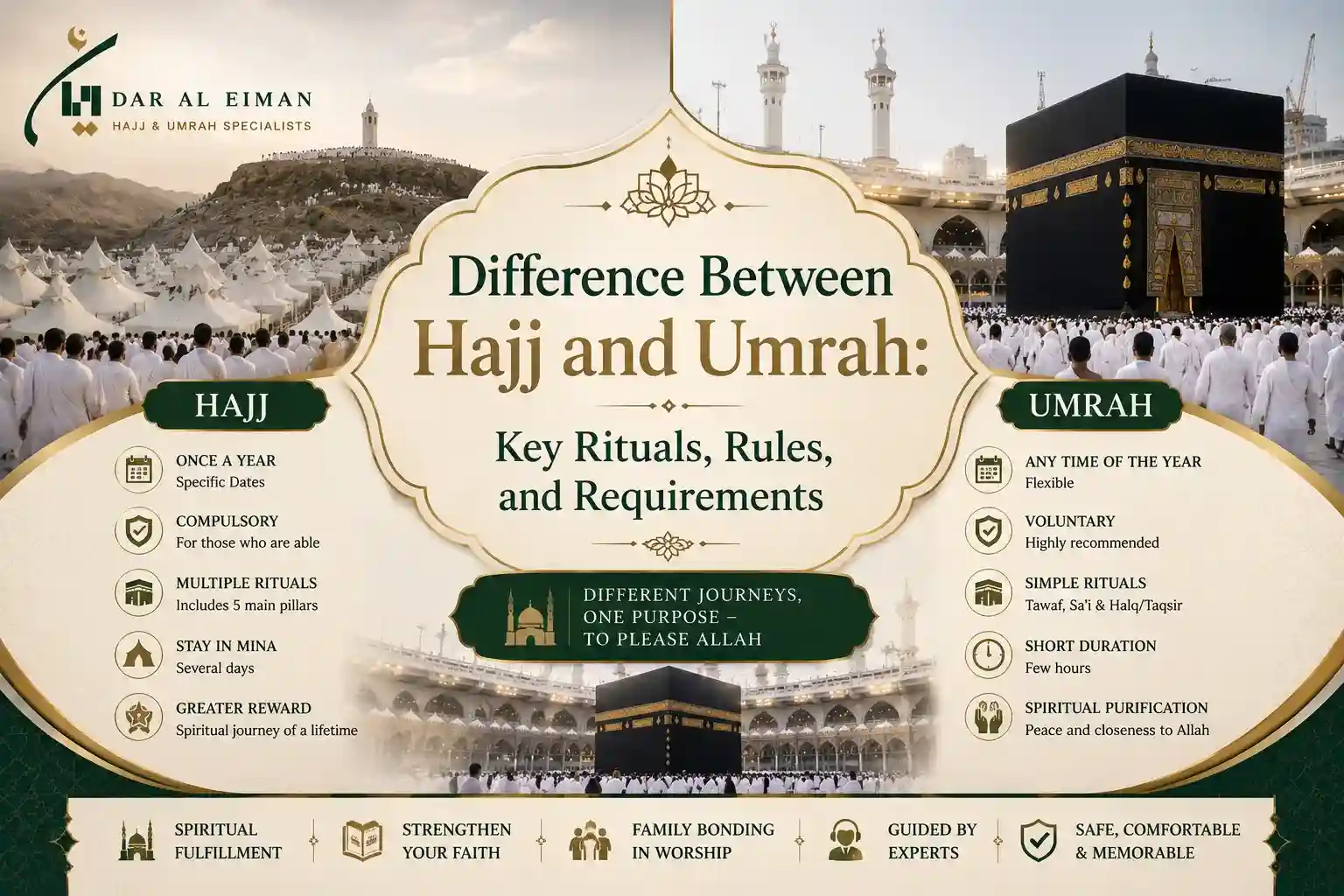
The table below breaks down the main Hajj and Umrah differences at a glance.
| Point of Comparison | Hajj | Umrah |
| Religious status | Obligatory, one of the five pillars | Voluntary, highly recommended |
| Timing | Fixed days in Dhul Hijjah only | Any time of the year |
| Duration | Around five to six days | A few hours to one day |
| Locations | Makkah, Mina, Arafah, Muzdalifah | Mainly Masjid al-Haram |
| Main rituals | Ihram, Tawaf, Sa’i, Arafah, Jamarat, sacrifice | Ihram, Tawaf, Sa’i, hair cutting |
| Crowds | The largest annual Muslim gathering | Smaller, depending on season |
| Frequency | Once obligatory, extra times optional | Can repeat many times |
| Visa Requirements | Dedicated Hajj visa (Hajj permit required) | Umrah visa or another eligible Saudi entry visa |
The main difference between Hajj and Umrah comes down to this: Hajj is a duty, while Umrah stays voluntary. This table sums up the core Hajj rituals vs Umrah rituals that every pilgrim should know before booking a trip.
Similarities Between Hajj and Umrah
The difference between Hajj and Umrah does not erase what they share. Even with clear differences, Hajj and Umrah carry one spiritual purpose. Both draw a believer closer to Allah. Both begin with Ihram, a state of purity that removes outward differences of wealth and status.
However, both include Tawaf, circling the Kaaba seven times, and Sa’i, walking seven times between Safa and Marwah in memory of Hajar’s search for water. Both end with shaving or trimming the hair. These shared acts point to the same values: patience, sacrifice, and gratitude. This is also why so many families combine both trips through a single Hajj Packages booking.
Can Umrah Replace Hajj?
A common question is whether Umrah can stand in for Hajj. It cannot, and this is one of the most important parts of the difference between Hajj and Umrah to understand early. Umrah remains deeply rewarding, but it does not fulfill the obligation that Hajj carries.
Hajj becomes a duty once a Muslim has the health, the money, and safe access to travel. Performing Umrah, even many times, does not lift that duty.
Allah says:
وَلِلَّهِ عَلَى النَّاسِ حِجُّ الْبَيْتِ مَنِ اسْتَطَاعَ إِلَيْهِ سَبِيلًا
“Pilgrimage to this House is an obligation by Allah upon whoever is able to find a way to it.” (Surah Al-Imran 3:97)
Hajj fulfils a required duty. Umrah adds its own separate reward, without ever replacing that duty once a person qualifies for it.
When Do Muslims Choose Umrah Instead of Hajj?
Many Muslims perform Umrah well before they can manage Hajj. Some are still saving for the cost. Others have not yet met the conditions that make Hajj obligatory. Health or travel limits can also make Hajj difficult for a time. Since Hajj visas run on fixed government quotas each year, Umrah gives many Muslims a flexible way to visit Makkah in the meantime. Many choose a Ramadan umrah packages deal timed around the blessed month.
Hadith About Umrah in Ramadan
The Prophet ﷺ gave special praise to Umrah performed during Ramadan. Ibn Abbas narrated that the Prophet ﷺ told a woman from the Ansar:
عُمْرَةٌ فِي رَمَضَانَ تَعْدِلُ حَجَّةً
“An Umrah during Ramadan is equal to Hajj.” (Sahih Al-Bukhari 1782, Sahih Muslim 1256)
This reward is real, but scholars are clear on what it means. It speaks to the reward of the act, not a substitute for the actual obligation of Hajj. A Muslim who is able to perform Hajj still must do so, even after a Ramadan Umrah.
How Many Umrahs Equal One Hajj?
No authentic Hadith gives an exact number here. A person could perform Umrah once or many times, and the duty of Hajj still stands once they become able to complete it. The Ramadan Hadith speaks only to reward, not to legal requirements. Ten Umrahs will not replace one required Hajj. Hajj and Umrah remain two separate acts, each valuable in its own right.
Rewards of Performing Umrah
Umrah carries a beautiful promise of forgiveness. Abu Huraira narrated that the Prophet ﷺ said:
الْعُمْرَةُ إِلَى الْعُمْرَةِ كَفَّارَةٌ لِمَا بَيْنَهُمَا، وَالْحَجُّ الْمَبْرُورُ لَيْسَ لَهُ جَزَاءٌ إِلَّا الْجَنَّةُ
“One Umrah to the next is an expiation for the sins committed between them, and an accepted Hajj has no reward except Paradise.” (Sahih al-Bukhari 1773, Sahih Muslim 1349)
Allah forgives the sins of a sincere pilgrim between one Umrah and the next. This promise gives strong motivation to return again, and many families now plan yearly trips through trusted Umrah Packages for this exact reason.
Rewards of Performing Hajj
Hajj asks much of a person in effort, cost, and devotion, which is why its reward carries such weight. The Prophet ﷺ said:
مَنْ حَجَّ فَلَمْ يَرْفُثْ وَلَمْ يَفْسُقْ رَجَعَ كَيَوْمِ وَلَدَتْهُ أُمُّهُ
“Whoever performs Hajj and does not commit any obscenity or wrongdoing will return like the day his mother gave birth to him.” (Sahih Al-Bukhari 1521, Sahih Muslim 1350)
An accepted Hajj, known as Hajj Mabroor, brings forgiveness of sins and a deeper bond with Allah. It also places the pilgrim in the footsteps of the Prophets who came before.
Preparation Tips for Pilgrims
Good preparation, for Hajj or Umrah, makes the days ahead easier and far more meaningful. Sort your documents early, including a valid passport, visa papers, and health requirements, since busy seasons bring extra delays. Learn the steps of Ihram, Tawaf, and Sa’i before you fly, so you can focus on worship once you arrive.
Pack light and comfortable, since Makkah runs warm and pilgrims walk long distances. Build up some walking stamina beforehand, and rest when needed once you are there. Keep a small daily budget for food and transport so nothing catches you off guard. Finally, choose a trusted Hajj Packages or Umrah Packages provider, since good guidance leaves more room for worship and less for logistics.
Begin Your Sacred Journey With Dar Al Eiman
Hajj and Umrah both hold real weight for a Muslim’s faith, even though they ask for different things. Hajj completes a pillar of Islam, while Umrah offers a standing invitation to worship and seek forgiveness at any time.
No two pilgrims arrive at this journey the same way. Some start with an Umrah trip years before their first Hajj. Others spend a lifetime preparing for the one journey ahead. Comparing Hajj vs Umrah matters more than which path you start on. Understanding the difference between Hajj and Umrah helps every pilgrim choose the right trip at the right time.
At Dar Al Eiman, our all inclusive packages are built around comfort, clear guidance, and peace of mind for every pilgrim we serve.